
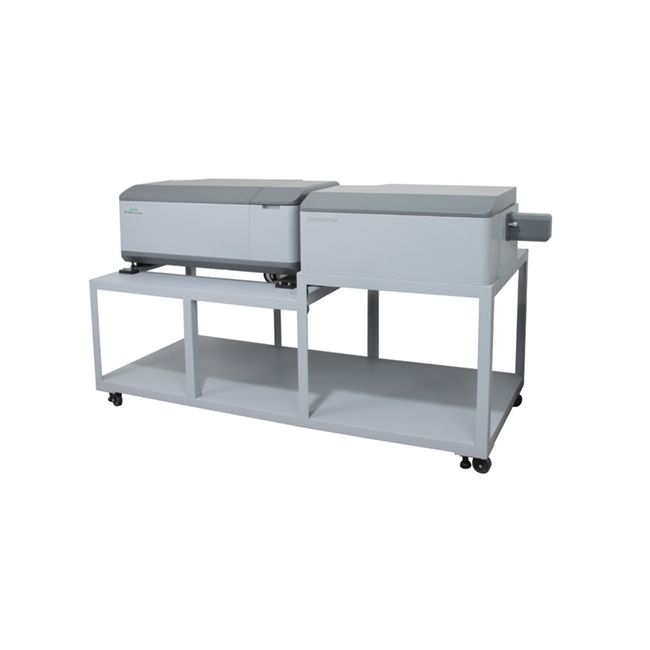
CPL-300 Circularly Polarised Luminescence (CPL) Spectrophotometer
£0.00
JASCO’s uniquely designed CPL-300 allows detection of a very weak CPL signal with an unparalleled degree of reliability and ease of use. The CPL-300 is designed with two monochromators: an excitation monochromator generates monochromatic depolarized light which excites a chiral sample and an emission monochromator collects the fluorescence light emitted by the sample. A unique piezoelastic modulator and ultra-sensitive photomultiplier tube allow detection of the CPL signal.
Availability:
In stock
SKU
CPL-300
CPL-300 Circularly Polarised Luminescence (CPL) Spectrophotometer
The circularly polarised luminescence spectrophotometer supplements the information obtained from other chiroptical techniques such as electronic or vibrational circular dichroism. Circular dichroism (CD) spectroscopy is widely used in the study of optically active substances. CD spectroscopy provides information about the structure of optically active substances in the electronic ground state, however, CPL spectroscopy provides information about excited states. The two techniques are therefore complementary.
Materials that exhibit circularly polarised luminescence are being actively investigated in applications such as liquid crystal display backlights, 3D displays, holographic displays, light sources for controlling plant growth, and security systems for optical communications and printing. It is therefore important to identify molecules that emit one-handed circularly polarised light with high quantum yield. CPL spectra contain important information such as the stable structure of excited molecules, and the behavior of these molecules in chemical reactions that involve an intermediate excited state. However, fluorescence emission is generally weak and CPL signals are even weaker, making it difficult to detect. The CPL-300 offers high sensitivity for the detection of these weak signals over a wide spectral range.
The standard ozone-free 150W Xe arc lamp can be replaced with a Hg/Xe source. The instrument’s unique double-prism excitation and emission monochromators offer very low stray light and no spurious linear polarization effects caused by instruments that use diffraction gratings. These are both extremely important as CPL signals tend to be very weak.
Features
- Double-prism monochromator
- Highly selected PMT for UV/Visible range with red sensitive PMT and InGaAs detector options for NIR detection
- Low stray light, no second-order radiation, and no Wood’s anomalies
- 180° sample geometry with unpolarised excitation light
- Samples with different transition moments for absorption and fluorescence, that do not become depolarised, can be measured
- Excitation (Ex) and emission (Em) monochromators
- Selectable Ex wavelength and Em spectral bandwidth
- Increased fluorescence sensitivity
- Data collection and processing
- Simultaneous measurements of CPL and fluorescence intensity
- One-click data conversion to DI and glum